
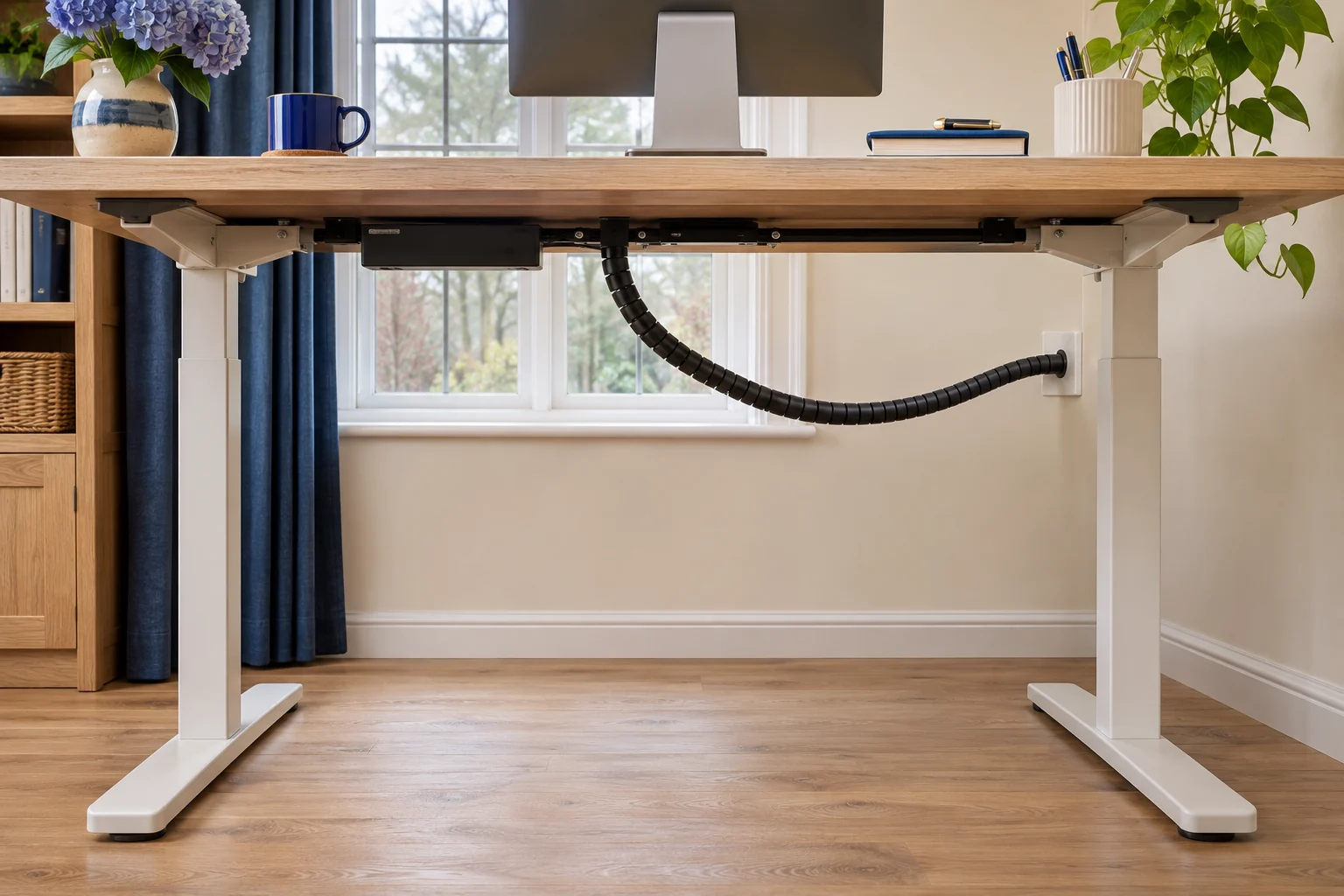
The fit comparison
Compare the published fit limits
The outside diameter includes the sleeve material. Confirm the usable opening and leave enough slack at the connectors and moving bends.
Scroll across the table for every fit check.
| Model | Length | Diameter | How it opens |
|---|---|---|---|
| D-Line Cable Tidy Tube 1.1 m, black For a shorter, wider bundle | 1.1 m | 32 mm outer, 26 mm inner | Pre-split side opening |
| D-Line Cable Zipper 2.5 m, black For a longer, slimmer run | 2.5 m | 25 mm outer | Side entry with supplied tool |
Separate moving leads from fixed leads
Start with the standing-desk cable layout. Mark the leads that stay with the moving top and the ones that run to a wall socket, fixed tower or data point. Group leads that share a route and have enough slack to move together. Leave frequently changed leads separate if removing one would mean opening the whole sleeve.
Hold the intended bundle loosely at its widest point and measure across it. Compare that with the sleeve’s usable inner diameter, leaving room for the leads to settle without forcing them. An outer diameter includes the sleeve material. A bundle of 24 mm may need more room than a sleeve labelled 25 mm can provide.
D-Line split tube for a short, wider bundle
The 1.1 m black D-Line Cable Tidy Tube is pre-split along its side. The published diameter is 32 mm outside and 26 mm inside. The side opening lets you place the cables in the sleeve without threading their plugs through a closed end.
For a shorter, wider bundle
D-Line Cable Tidy Tube 1.1 m, black
The pre-split flexible tube gives short bundles a wider sleeve that opens from the side.
Check the 26 mm inner diameter against the relaxed bundle. Use only where the tube can bend freely.
- 1.1 m long
- 32 mm outer diameter
- 26 mm inner diameter
Give the sleeve room to curve without catching the frame or pulling the leads. Keep the ends outside the sharpest part of a bend. If the tube will not flex easily over the route, shorten the sleeved section or leave the moving bend free. Follow the cable makers’ guidance on bends and bundling.
D-Line Cable Zipper for a longer run
The black Cable Zipper is 2.5 m long with a 25 mm outer diameter and comes with a feeding tool. It can cover a longer run with fewer joins. Check the usable capacity before choosing it for multiple leads, and use the tool as instructed. Keep bulky connectors and power bricks outside the sleeve.
For a longer, slimmer run
D-Line Cable Zipper 2.5 m, black
The longer 25 mm outer-diameter sleeve uses a tool to feed a compatible bundle into the split.
Check the usable opening with the maker. Keep enough lead free at both ends for the desk’s travel.
- 2.5 m long
- 25 mm outer diameter
- Zip tool included
Measure the length you need with the desk at its highest position and the cables in their intended route. Leave exposed slack near the moving and fixed ends. At the lowest height, check that the sleeve does not form a tight fold or fall under the chair. Follow the instructions for cutting and make sure the finished ends do not rub against the cables.
Test the route through the whole range
Keep people and objects clear of the desk and move it according to the instructions. Observe the sleeve through the intermediate positions as well as at the ends. Check where it crosses the frame and where the leads leave the bundle. Stop if the loop catches, a connector moves or a lead goes taut. Recheck after changing equipment. Keep plugs accessible and follow Electrical Safety First’s advice on extension leads and loading.
Common questions
How large should the sleeve be?
Measure the relaxed bundle and compare with the usable inner diameter, allowing room for movement.
Do I need to pass the plugs through the sleeve?
Both options open from the side. Follow the instructions for the split tube or feeding tool.
Should the sleeve cover the full cable length?
Cover the shared run where it bends freely. Leave the ends and connectors accessible and enough slack for the desk’s travel.
What if the cable sleeve catches at one height?
Stop the desk and change the route or sleeve length. Test all intended positions before using the setup again.
Can I put a power brick inside?
Keep power bricks and plugs accessible and ventilated according to their instructions. Use the sleeve for compatible leads.
Sources and selection
Sources and Amazon UK listings checked in November 2026. This guide uses published specifications and fitting guidance.