
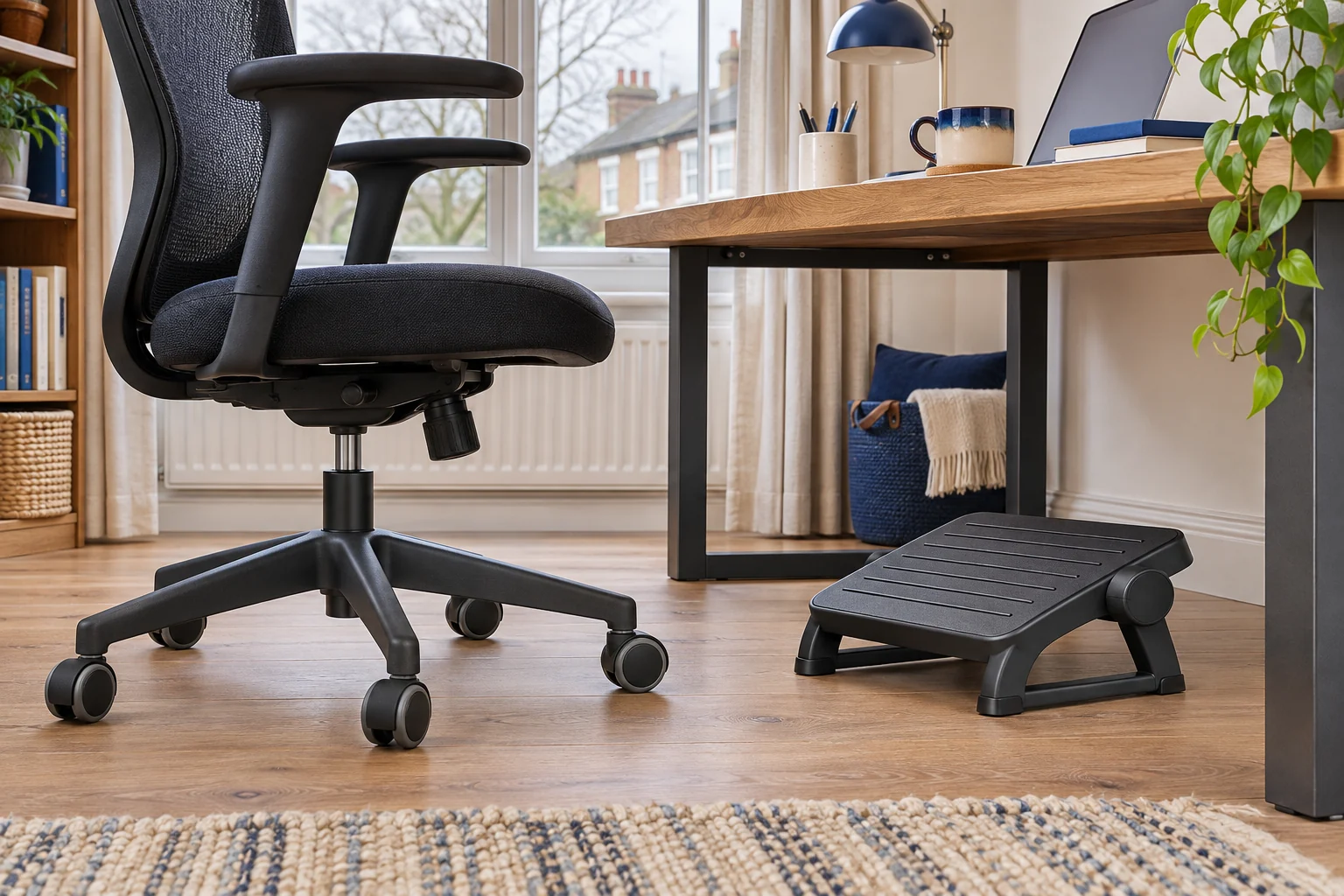
Find the first point of contact
Set the chair where you can reach the keys comfortably. Keep your feet on the floor for the first test if the chair allows it. Roll in and turn as you normally do. Ask someone to watch which part contacts the footrest first. A castor can swing out as it turns, and a base spoke can reach farther forward than the seat. Mark those positions on the floor with removable tape.
Then put the footrest where both feet settle when you sit back. Trace its floor footprint, including the legs or underside. Check its moving position too if the platform rocks or tilts. If the two outlines overlap only on one side, try changing the approach angle or shifting the platform slightly. Retest where your feet land before keeping the change.
Check the full base of a rigid platform
The Kensington SoleMate Plus offers a published 8.9–12.7 cm platform height and up to 30° of tilt. Measure the outer base, not just the useful place for your feet. Set it at the angle you use and check that the front of the platform clears the wheels and that your toes remain under the desk.
A rigid tilting platform
Kensington SoleMate Plus
A rigid platform with a foot-operated adjustment suits a seated setup where you want to change the angle without moving the base.
The listed height is about 9–13 cm. Check the outside base on your floor and measure the part of the tilted platform where your feet actually land.
- 8.9–12.7 cm listed height
- Up to 30° tilt
- Foot-operated adjustment
A deeper base can push your feet too far back if a rear rail stops the platform. Move it forward in small steps. If that brings the front edge into the castor sweep, use the remaining floor depth to shortlist a shallower option.
Check compression and grip on a cushion
The Duronic FT06 has a 44 × 30 cm combined footprint and a published unloaded height of 17 cm with both pieces stacked. The height under your feet will depend on how it compresses. Trial both configurations as instructed and check whether it stays put on the actual floor.
A cushion that packs away
Duronic FT06 cushion footrest
The FT06 uses a curved top cushion and a removable flat base. The combined footprint is 44 × 30 cm, and the cushion can move with a temporary work setup.
The combined 17 cm height is an unloaded outer measurement. Check the height under your feet and whether the base grips your actual floor.
- 44 × 30 cm footprint
- 17 cm unloaded when stacked
- Two cushion pieces
Keep your soles supported in the position you use for typing. If the cushion slides towards the chair when you move your feet, reconsider its position or choose a suitable platform with more grip. Keep the wheels clear and give the platform room to sit flat.
Retest with the keyboard and drawers in use
Try moving forward to type, turning to reach a drawer and pulling back to stand. Check both feet and the chair through those movements. If avoiding the collision makes you sit farther from the keys or raise your shoulders, review seat and worktop height. A lower work surface or different chair setting can reduce the footrest height you need and free some space beneath the desk.
Common questions
Why does the chair hit only when I turn?
A castor swings as it swivels. Mark the widest sweep while turning and compare it with the base of the footrest.
Can I push the footrest farther back?
Only if you can still rest both feet comfortably and there is room behind it for the whole base.
Will a cushion solve the problem?
Compare its actual footprint, grip and height under load. A softer material can still sit in the castor path.
Do I need to measure a rocking footrest differently?
Trace the maximum floor and toe space through the permitted tilt range.
What if the chair now sits too far from the keyboard?
Recheck seat and worktop height and the position of the platform. You should be able to reach the keys while sitting back.
Sources and selection
Sources and Amazon UK listings checked in November 2026. This guide uses published specifications and fitting guidance.