
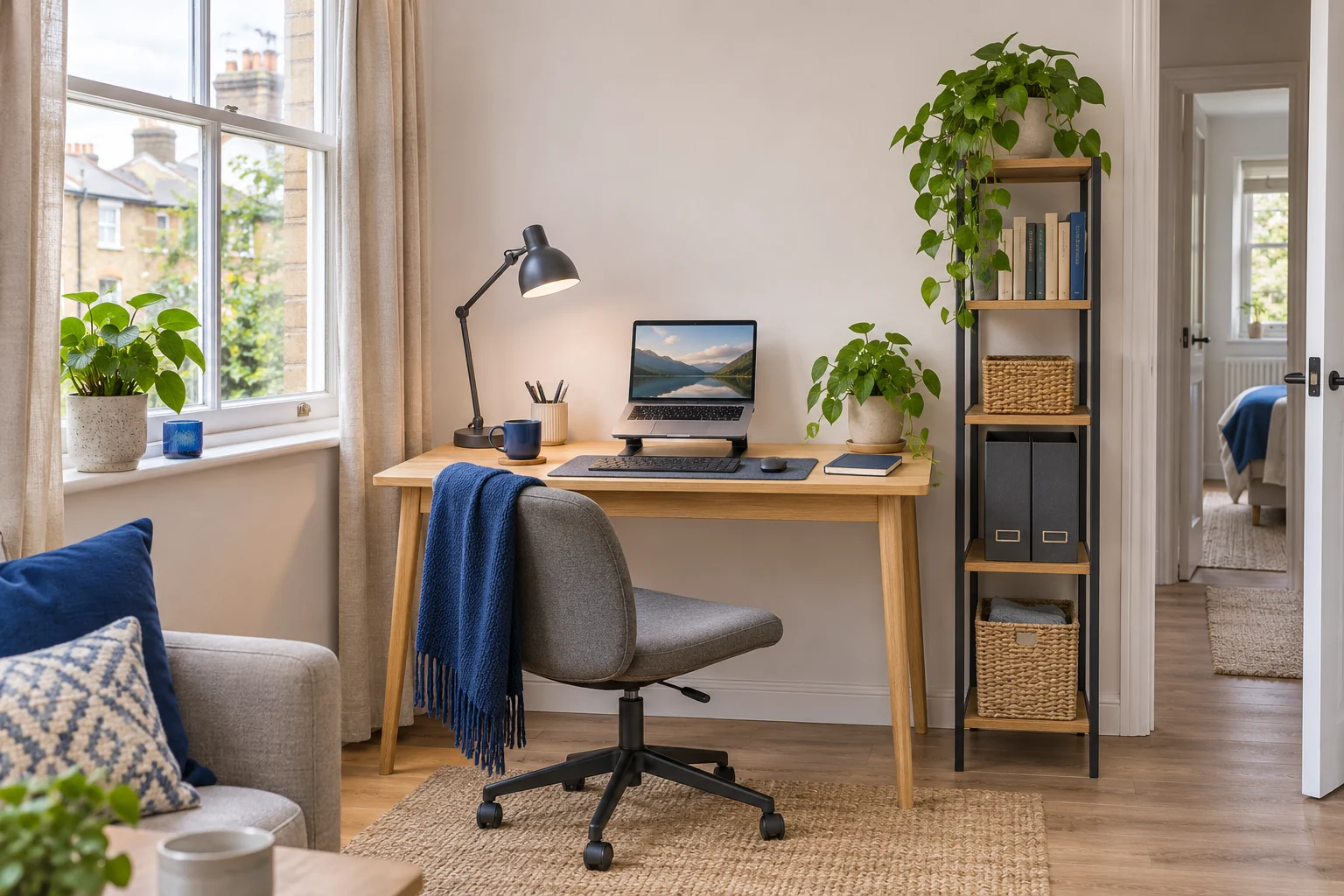
Choose a position that works with the flat
Walk the room as you use it in the morning and evening. Note doors, radiator controls, the closest socket and the space needed to pull out a dining chair or open a wardrobe. Choose a spot where the lead can stay beside the furniture and where you can stand up without blocking the door.
Try the position at the time you normally work. A desk can get direct light across the screen for part of the day. Rotate the equipment or change the lamp position while keeping the desk on a stable surface. Test the screen, keyboard and chair with the HSE workstation guidance and the space you have. Measure the chair in use as well as parked.
Check the tenancy agreement and ask about any work or adhesive fixing you are considering. Follow furniture stability instructions, including required restraints. Choose a different piece of furniture if you cannot meet its installation requirements. If you share the room, agree how you will store the equipment when you finish.
Use a folding surface if the room needs to reset
A wheeled desk can work for a small laptop setup with a parking spot nearby. The HOMCOM 836-606V00ND has an 80 × 40 cm open footprint and folds to roughly 9.5 cm deep. It has four wheels, two with brakes. Test the route with the desk empty and set the brakes while it is in use.
For a short roll to storage
HOMCOM 80 cm folding desk on wheels
The wheeled frame folds to a slim upright footprint and has two braked castors for use in position.
Trial a 40 cm deep surface with your kit. Check the storage route and floor transitions before choosing it.
- 80 × 40 cm footprint
- 9.5 cm folded depth
- Four castors, two braked
A 40 cm depth can fill quickly. Trial it with a keyboard and the plugs fitted. Measure whether a 75 cm working height fits you and check the leg opening. A rug edge or raised threshold can make a daily fold-and-roll routine awkward. Measure where the desk will park and make sure the folded desk can be stored securely following the maker’s instructions.
Use a freestanding monitor base on a stable desk
For a separate setup with a stable work surface, a freestanding VESA mount keeps its support on the desktop. The Duronic DM15D1 has a published base footprint of 36 × 22 cm, supports a listed 13–32 inch screen up to 8 kg and uses 75 × 75 or 100 × 100 mm VESA. Check the screen without its original stand and use the maker’s guidance for mounting hardware and assembly.
A broad freestanding base
Duronic DM15D1
A replacement upright stand for one compatible screen when you cannot attach a clamp. The published UK base footprint gives you a useful starting point for a paper template.
Use the manual-backed 8 kg limit and ±15° tilt; some manufacturer page text conflicts. UK published base is 36 × 22 cm. Confirm the current variant dimensions and desired screen-centre height before ordering.
- 13–32″
- Up to 8 kg
- VESA 75 × 75 or 100 × 100 mm
Tape the footprint onto the surface before ordering. Make sure the base rests fully on a stable top that can support the mount and screen. Try the original monitor stand on the same surface first and check the reach to the keyboard. Keep a screen on a stable dedicated surface where you can safely leave it, or plan a separate secure place to store it during pack-down.
Make the daily reset easy to repeat
Leave a clear place for the charger, mouse and headphones. Put a tray or box where you can reach it without opening a cupboard blocked by the chair. Unplug equipment before moving the desk and give cords a place to sit where they cannot trail into the walkway.
Use no-drill cable management if your own desk has a compatible edge or suitable finish. Give the extension block a stable accessible resting place and follow its rating. If you move rooms often, keep the cable arrangement small enough to carry and reset. Try the setup and pack-down once with everything you use before ordering extra furniture.
Measure the front door, stairs or lift before choosing a desk you might take to your next flat. Compare the assembled width and weight with what you can manoeuvre. Keep the assembly instructions and spare fasteners together so you can take the furniture apart safely if the route is tight.
Common questions
How can I set up a home office in a rented flat without drilling?
Use suitable freestanding furniture and place the desk near an outlet. Use removable cable fittings only on approved finishes and check the property requirements.
Can I use a monitor arm without attaching it to the desk?
A freestanding VESA mount uses a base on the top. Check the footprint, screen load and stability of the exact desk first.
Can I put cable clips on rented walls?
Check your tenancy and the surface instructions first. A suitable part of your own furniture gives you another place to guide the lead.
What if my desk is in the living room?
Mark the chair position, cable route and storage spot. Check that other people can pass and use the room while you work and after the desk is parked.
Do I need a folding desk?
Consider one if you need the floor back daily and can store the desk securely. A compact fixed desk can suit equipment that needs to stay set up.
Sources and selection
Sources and Amazon UK listings checked in November 2026. This guide uses published specifications and fitting guidance.