
The fit comparison
Compare the published fit limits
Use these published dimensions to shortlist a fit, then measure the space you have and check the exact version before ordering.
Scroll across the table for every fit check.
| Model | Height | Support surface | Adjustment and fit |
|---|---|---|---|
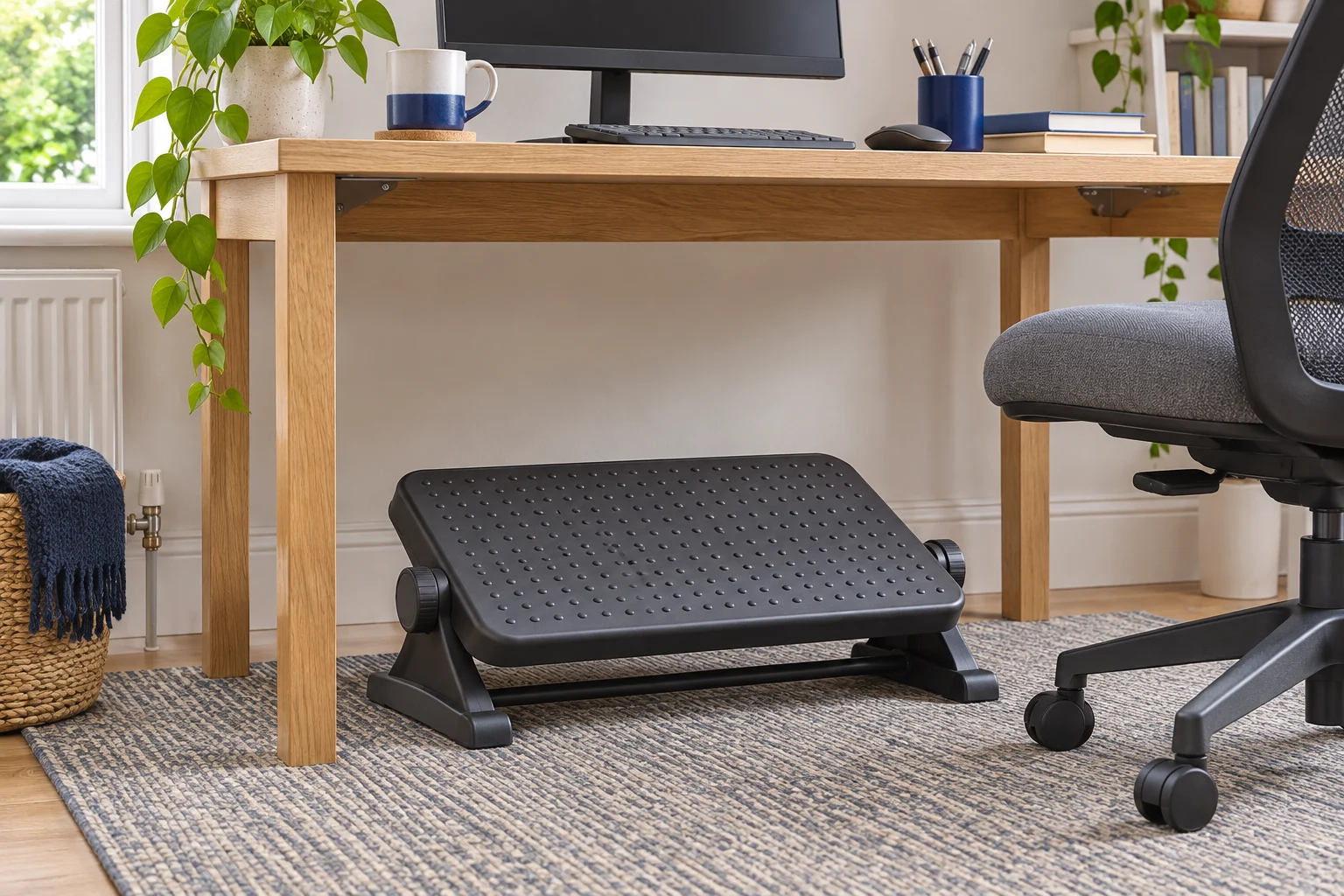
| Kensington SoleMate Plus A rigid tilting platform | 8.9–12.7 cm listed | Rigid textured platform | Foot-operated tilt, up to 30°. Check base clearance. |
| Duronic FT06 cushion footrest A cushion that packs away | 17 cm unloaded when stacked | 44 × 30 cm combined footprint | Add or remove the flat cushion. Check compression and grip. |
Measure where your soles need support
A footrest is useful when your chair needs to be higher to reach the keyboard and your feet would otherwise hang. Set the seat for the desk first. Keep the shoulders relaxed, sit back and check that the front of the seat leaves a comfortable gap behind your knees. If you can lower the chair and still reach the keyboard with the same posture, try that before choosing a platform.
With the chair at the height you intend to keep, try a stable, level support under both feet. Add height until your soles rest naturally without tipping forwards. Measure from the floor to the surface under your heels and check where the front of each shoe lands. Record the height with the chair in its working position, as you may sit differently if you pull it back for the measurement.
For example, if the trial surface is 11 cm high and both feet feel supported, compare that with the adjustable range of a rigid platform. For a cushion, compare the height while it is compressed by your feet. A tilting surface may sit higher under the toes than under the heels. If you only have a manufacturer’s edge height, ask where the measurement was taken.
Tape out the footprint under the desk
Measure the clear gap between the desk feet, a pedestal or any low crossbar. Measure the depth while sitting close enough to type. Check that you can place the platform where your feet naturally land and still have room to change position. Use the overall base dimensions for this trial and the usable platform dimensions for the width of both shoes.
Roll the chair in and out to check the castor path. If the footrest moves when you press on it, try the intended angle on your actual flooring and check that the feet or underside sit flat. A broad rigid base can be useful on hard floors. On a rug, check whether the pile makes the platform wobble or the cushion shift.
Kensington SoleMate Plus for a rigid adjustable platform
The black K52789WW has a foot-operated adjustment and a listed height of approximately 8.9–12.7 cm. It suits a setup that stays assembled and where you want a firm surface under both feet.
A rigid tilting platform
Kensington SoleMate Plus
A rigid platform with a foot-operated adjustment suits a seated setup where you want to change the angle without moving the base.
The listed height is about 9–13 cm. Check the outside base on your floor and measure the part of the tilted platform where your feet actually land.
- 8.9–12.7 cm listed height
- Up to 30° tilt
- Foot-operated adjustment
Check the outside base against the available space before choosing it for a narrow chair bay. Trial a flatter setting and a slight tilt. Put your feet where they naturally land and check the height at those points. A steeper angle can move your knees towards the desk edge.
Duronic FT06 for a setup you move or store
The FT06 combines a shaped top cushion with a flat lower piece. The maker gives a 44 × 30 cm combined footprint and a 17 cm outer height with the pieces stacked. Removing the lower piece changes the height, and each configuration compresses under load.
A cushion that packs away
Duronic FT06 cushion footrest
The FT06 uses a curved top cushion and a removable flat base. The combined footprint is 44 × 30 cm, and the cushion can move with a temporary work setup.
The combined 17 cm height is an unloaded outer measurement. Check the height under your feet and whether the base grips your actual floor.
- 44 × 30 cm footprint
- 17 cm unloaded when stacked
- Two cushion pieces
A cushion can be easier to tuck away when the room changes use. Check how much it compresses where your heels rest and whether it drifts when you move both feet. If you share the room, include it in your daily reset routine.
Recheck your chair after adding the support
Once the footrest is in place, sit at the keyboard and check the space behind your knees and under the worktop. If the platform lifts your thighs towards the underside, try a lower setting. If it makes you sit forwards to reach it, bring it closer and check the chair depth.
The desk-height guide helps you measure a workable key position. If your feet are now supported but you still cannot sit against the backrest with clear knees, use the seat-depth guide to assess the chair. A good final setup lets you reach the mouse, sit back and move your feet without first moving the platform.
If the castors catch the footrest, trace both footprints with the chair in use.
Common questions
How high should my desk footrest be?
Measure the height of a stable trial surface that supports both soles while you sit at the correct keyboard height. Check the height where your feet land.
Is a tilting footrest better than a flat one?
Try both positions with your own footwear. Choose the one that supports your soles and leaves your knees clear of the desk.
How much room do I need under the desk?
Measure the base, the free depth in your normal seated position and the path of the chair’s castors. Check that both shoes fit on the support surface.
Will a cushion reach its listed height when I use it?
Its height can reduce under pressure. Compare the loaded height with your trial measurement and check whether the cushion holds its position.
Should I set the chair or the footrest first?
Start with the seat and keyboard position. Then choose foot support that fits the resulting gap and recheck the space behind the knees.
Sources and selection
Specifications and Amazon UK variants checked in November 2026. The comparisons use published dimensions and fitting guidance.