
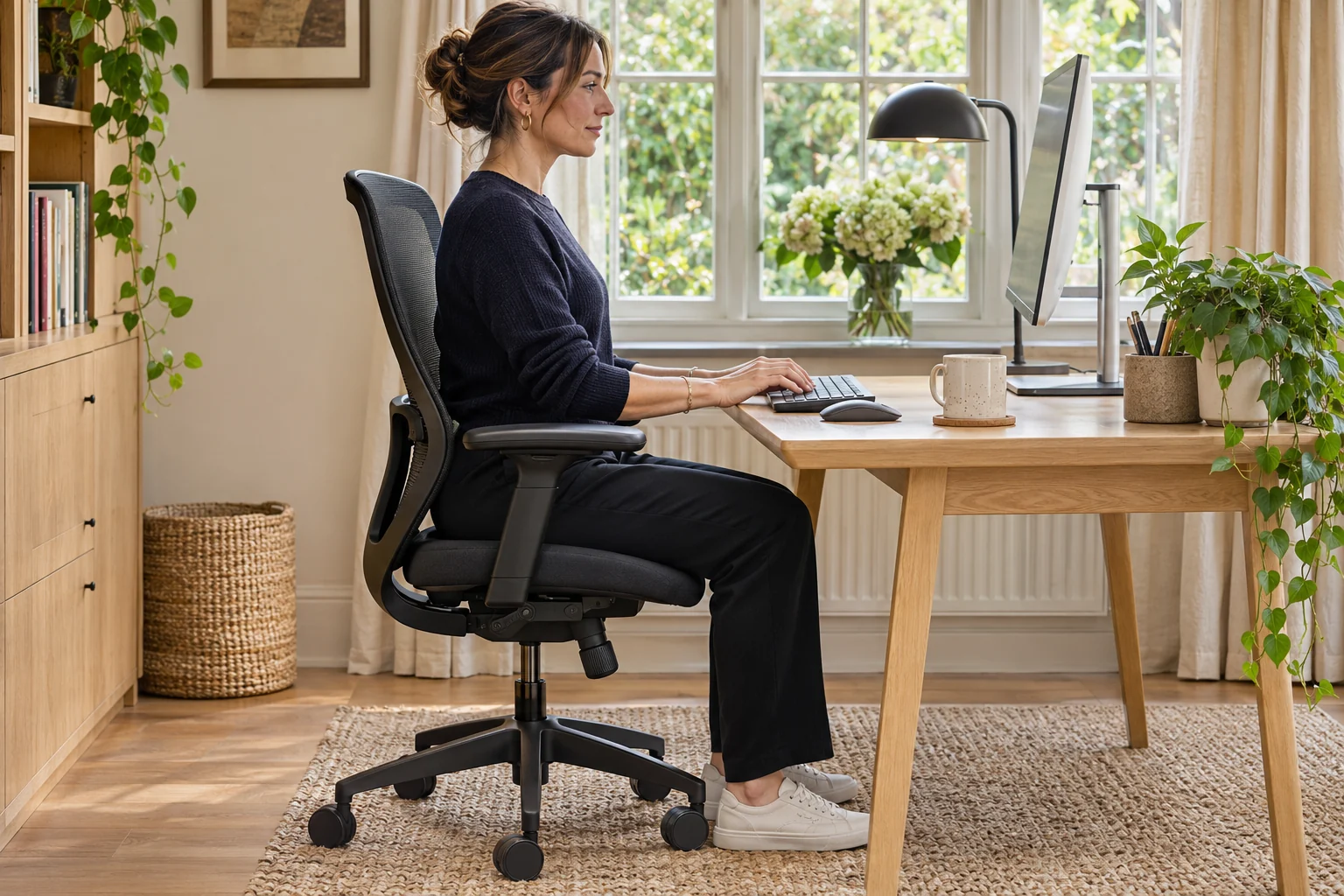
The fit comparison
Compare the published fit limits
Angles below describe the seat pan. Backrest angles use a separate measurement.
Scroll across the table for every fit check.
| Model | Forward seat angle | Back movement | Fit check |
|---|---|---|---|
| Boulies OP180, black mesh back 2° selectable forward seat tilt | 2° stated forward seat tilt | Separate adjustable backrest | Try the seat angle with supported feet. |
| Boulies OP300, black mesh back Seat angle plus separate rocking | 1.7° stated forward seat tilt | Separate backrest and rocking controls | Check the exact mesh-back variant and manual. |
Separate the seat angle from the backrest
Read the mechanism description and the arrows on the drawing. A forward-moving backrest changes where the back support meets you. A forward seat-angle setting changes the slope under your thighs. A seat-depth slider moves the pan forwards or backwards. Check that the feature you want is actually provided on the selected model.
Start from the chair’s normal neutral setup with feet supported. Set seat height and depth, then try the forward angle using the manual. Check whether you feel secure on the seat and can type without sliding forwards or bracing your feet. Keep the mouse and keyboard close enough to use with relaxed shoulders.
Boulies OP180 with a stated 2° forward setting
Boulies’ UK comparison lists 2° forward seat tilt with position lock for the OP180. It also has seat-depth adjustment and a separately adjustable backrest. The selected black mesh-back model has a foam seat. Match those controls and materials to the exact listing when ordering.
2° selectable forward seat tilt
Boulies OP180, black mesh back
Boulies documents a selectable 2° forward seat tilt with position lock on OP180.
Try the seat angle with feet supported and check the backrest and arm position separately.
- 2° forward seat tilt
- Seat angle position lock
- Adjustable seat depth
The maker gives backrest angles separately from the seat angle. Use the manual to identify the relevant lever and permitted adjustment sequence. Try returning to neutral as well as moving forwards. Check that you can operate the control from a stable sitting position.
Boulies OP300 with a stated 1.7° forward setting
The OP300 has a documented forward seat angle of 1.7° and backward angle of 7.8°, with position lock. It also provides a separate rocking function. The selected listing is the black mesh-back version with a foam seat and headrest. Keep these functions separate when trying the controls.
Seat angle plus separate rocking
Boulies OP300, black mesh back
The OP300 has a stated 1.7° forward and 7.8° backward seat angle with position lock.
Check the seat setting independently of the backrest recline and the rocking function.
- 1.7° forward seat tilt
- 7.8° backward seat tilt
- Position lock and rocking function
A larger numerical angle does not establish the better fit. Try the contact at your thighs, lower back and feet with the seat depth set correctly. The headrest and arms need their own adjustment after you have settled into the position.
Try the angle during the work you do
Use a short typing task, mouse movement and writing by hand to check the setup. Confirm the keyboard height at the selected seat angle. If changing the slope changes where your hands meet the keys, adjust the permitted work surface or chair settings and repeat the check.
Keep a neutral setting available for other tasks and follow the maker’s guidance on changing position. If you share the chair, try the forward setting separately for each person. Record the seat depth and arm positions alongside the angle. A feature label cannot show how the specific pan contour and controls will feel to an individual user.
Common questions
Does forward tilt mean the backrest moves forwards?
Check the drawing. This guide compares forward seat-angle settings, which are separate from backrest movement.
Is moving the seat forwards the same feature?
A depth slider moves the pan horizontally. A tilt setting changes its slope.
Can I lock the seat at a forward angle?
Check the model’s mechanism and manual. Boulies documents forward position lock on the two examples here.
Should I increase the seat height for forward tilt?
Set height for supported feet and recheck key height after changing angle. Use the position that fits your task.
Is the larger forward angle always preferable?
Try the actual chair. Seat shape, depth, back contact and foot support affect the result.
Sources and selection
Sources and Amazon UK listings checked in November 2026. This guide uses published specifications, manufacturer instructions and measurements to take in your own setup.